
Contemporary Japanese culture: anime, oshi-katsu, publishing, and street districts
Read today's Japanese culture through the ¥3.84 trillion anime market, manga publishing, oshi-katsu spending, Comiket, Shimokitazawa, Koenji, and design retail.
Current culture in Japan is easier to understand as a set of industries and walking routes than as a vague idea of “cool Japan”. Anime, manga, oshi-katsu, small theaters, used-clothing streets, publishing, and design retail all meet in real neighborhoods.
Anime and manga markets
The anime industry reached a record ¥3.8407 trillion in 2024, and the overseas share is now 56 percent according to the Association of Japanese Animations. Streaming, licensing, events, and goods now matter as much as domestic TV broadcasting.
Television anime still moves at high volume, with roughly 200 to 250 titles a year. Useful studio names include Kyoto Animation in Uji, MAPPA, ufotable, A-1 Pictures, Studio Ghibli in Koganei, and bones in Tokyo.
The manga market reached a record ¥704.3 billion in 2024, with digital manga at 72.7 percent of total sales while print volumes keep falling. Weekly Shonen Jump, Weekly Shonen Magazine, and Weekly Shonen Sunday remain reference points, but Jump+, Piccoma, LINE Manga, Kindle, and Comic Cmoa changed where people read.
Oshi-katsu and fan spending
Oshi-katsu means supporting a favorite idol, character, voice actor, performer, or creator. The market is often estimated around ¥350 billion, and the strongest participation is among people in their 20s and 30s.
Typical spending includes live tickets around ¥6,000 to ¥15,000, stage tickets around ¥8,000 to ¥25,000, CDs, photo cards, acrylic stands, birthday ads, and travel to locations linked to a series. A station birthday ad can cost ¥30,000 to ¥200,000 when fans split the bill.
The activity is public online. X hashtags such as birthday tags, TikTok dance covers, YouTube song covers and game streams, pixiv illustrations, and BOOTH sales all sit inside the same fan economy.
Comiket and doujin culture
Comic Market began in 1975 and is held twice a year, in August and December, at Tokyo Big Sight. The current format is 2 days with around 250,000 visitors (C106 in summer 2025) and roughly 23,000 circle spaces; pre-pandemic 4-day events exceeded 700,000 visitors in total.
Doujinshi usually cost about ¥500 to ¥2,000, and print runs can range from 100 copies to several thousand. BOOTH, Melonbooks, and Toranoana extend the market outside the event hall.
Cosplay has its own areas and rules. The sales halls are not a free photography zone, and copyright tolerance around fan works depends on scale, behavior, and whether the activity becomes commercial.
Independent districts
Shimokitazawa sits on the Keio Inokashira Line and Odakyu Line. It has more than 100 used-clothing shops, over 20 live houses such as Shelter and Club Que, and the Honda Theatre cluster. The 2022 station redevelopment changed the streets, but small-shop culture remains.
Koenji on the JR Chuo Line is linked with used clothing, jazz cafes, zines, old bars, and the Koenji Awa Odori. The late-August dance festival can bring about 1.5 million visitors.
Kichijoji, Kuramae, and Kiyosumi-Shirakawa show other versions of the same pattern. Kichijoji has Inokashira Park and Harmonica Yokocho, Kuramae grew from wholesale streets into coffee and stationery, and Kiyosumi-Shirakawa became a third-wave coffee district after Blue Bottle opened in 2015.
Publishing and design
Kodansha, Shueisha, Shogakukan, and Kadokawa still anchor much of the magazine, manga, light-novel, and media-mix system. New paperback series such as Kodansha Gendai Shinsho, Iwanami Shinsho, Chuko Shinsho, and Shincho Shinsho keep general education publishing visible at about ¥800 to ¥1,200 per book.
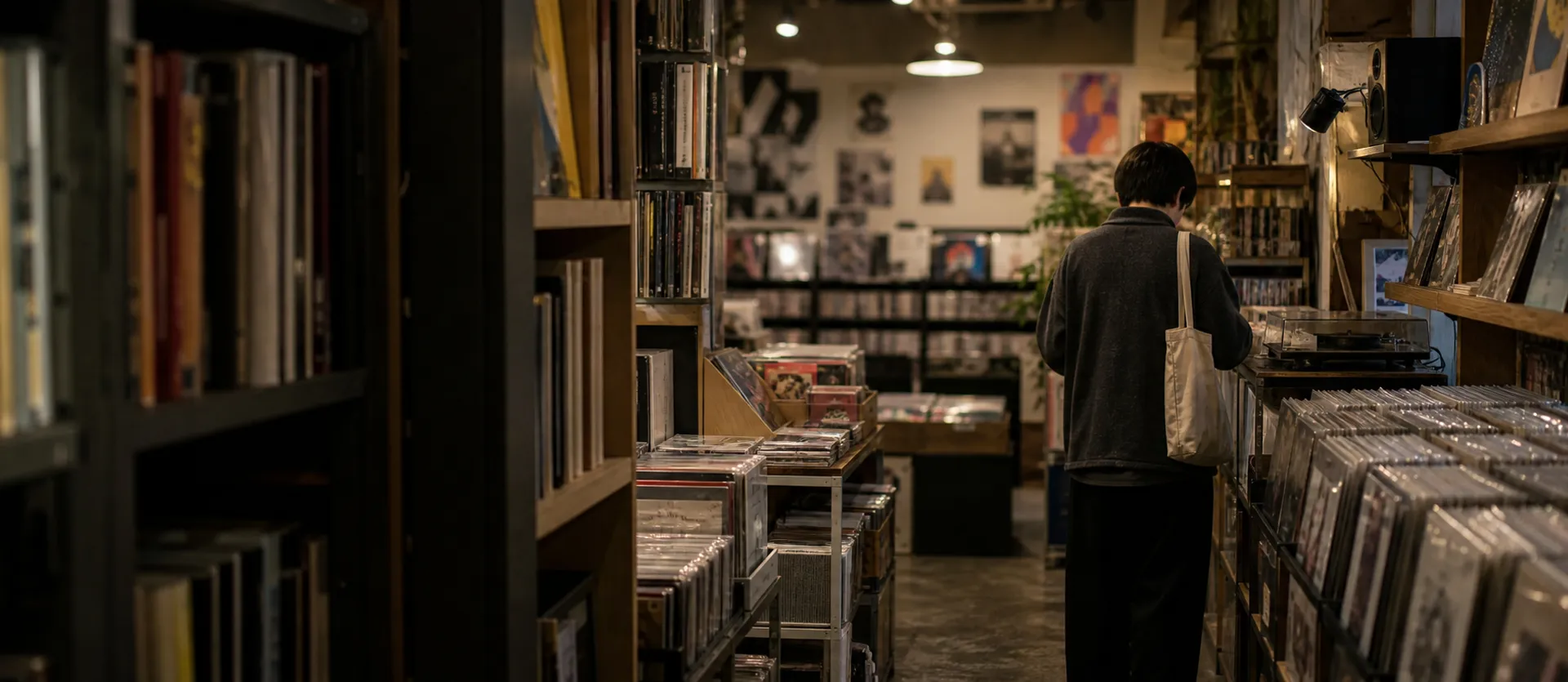
Bookstores matter as cultural infrastructure. Kinokuniya Shinjuku, Maruzen Marunouchi, Junkudo Ikebukuro, Tsutaya, Book Off, and Daikanyama Tsutaya each represent a different way to buy and browse.
Minimal design is not just an aesthetic. MUJI began in 1980 and now has more than 1,000 stores worldwide, while architects such as Tadao Ando and Kengo Kuma shaped concrete, wood, light, and natural-material design for public attention. Handmade platforms such as Minne and Creema also keep small craft sellers visible online.
Common mistakes
Do not treat “subculture” as one group. Anime fans, idol fans, cosplayers, jazz cafe regulars, theater people, and zine readers overlap, but they do not share the same rules.
Do not assume Comiket is mainly a cosplay show. Cosplay is mostly limited to assigned areas, while the main sales halls are built for doujin circles, queues, and movement.
Ghibli is important, but it is not the whole anime industry. Current production is shaped heavily by TV anime, manga, light novels, streaming platforms, music labels, and merchandise committees.
Useful terms
- anime and manga
- oshi-katsu
- Comiket
- doujinshi
- seichi junrei