
Higashi Chaya: 1820 System, Shima ¥500 / Kaikaro ¥750, Half-Day Route
Kanazawa's Higashi Chaya district is the product of the Kanazawa domain's 1820 teahouse consolidation system. Shima (Important Cultural Property) ¥500, Kaikaro ¥750, Hakuza gold-leaf shop free, Omicho → Kenrokuen → Higashi Chaya half-day route, Castle Town Loop Bus ¥220, the boundary after sunset.
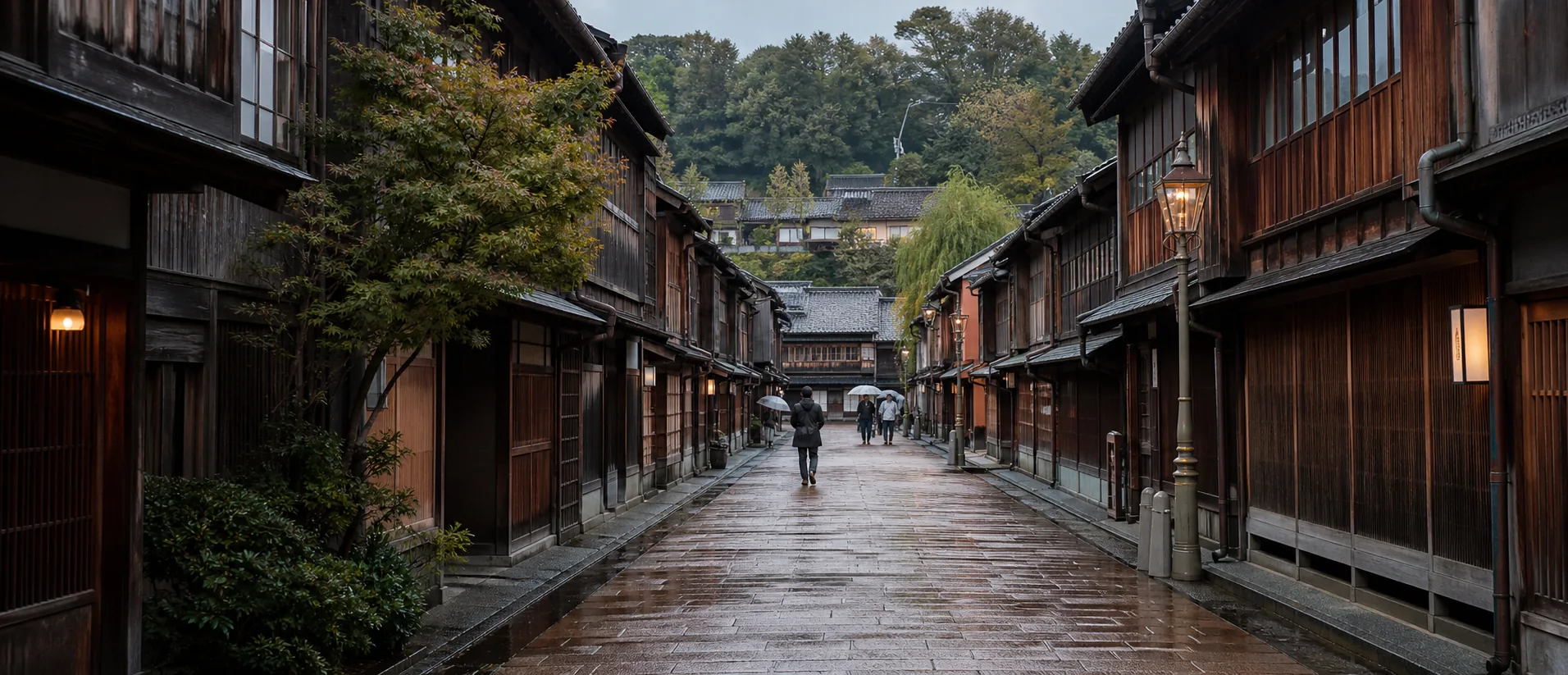
Higashi Chaya (ひがし茶屋街) on the east bank of the Asano River is the place in Kanazawa most easily simplified by a photograph. Wooden lattices, stone-paved streets, gold-leaf soft serve, and kimono-wearing tourists are visible. But what really gives this district its texture is the spatial order the Kanazawa domain left behind when it consolidated scattered teahouses to the outskirts of the castle town in 1820: narrow entrances, high second floors, daytime tourist shops and the teahouses still operating at night belong to two different worlds. This article unpacks it in 5 layers: historical system → architecture details → time periods → half-day route → cross-district extensions, with concrete fees, hours, and bus stops.
1. The 1820 system: why teahouses concentrated
Many teahouses scattered through the castle town of Edo-period Kanazawa. In 1820 (Bunsei 3), the Kanazawa domain used a “machi-furi” (public notice) to concentrate these teahouses into 3 specific districts on the outskirts of the city center: Higashi Chaya (largest), Shukei-machi Chaya (on the opposite bank of the Asano River), and Nishi Chaya (south of the Sai River).
Here “teahouse” doesn’t mean a casual tea-drinking shop, but a place to entertain guests with geiko playing shamisen, dancing, and zashiki games. In the Kanazawa context, geiko are usually called “geiko” (げいこ) or “geiko” (and the term has the same characters as Kyoto’s geiko / geiko, though Kyoto distinguishes “maiko” / 舞妓; Kanazawa basically uses only “geiko”).
The history also explains why the district looks different from ordinary townhouses. Outside of teahouses, fine wooden lattices “kimusuko” (木虫籠) are typical, with Japanese guest rooms on the upper floor. Edo-era domain policy restricted two-story buildings to teahouses, so the height and façade of rows of teahouses stood out from surrounding residences. So the beauty of Higashi Chaya isn’t only in “old houses” — it’s in an architectural language jointly shaped by entertainment, status, and city management.
Sources: Kanazawa City: Higashi Chaya (Important Preservation District), Agency for Cultural Affairs: Important Preservation Districts List.
2. What to look for in the architecture: kimusuko / second-floor rooms / red earth walls
The four elements worth slowing down for on the main street: kimusuko (the fine wooden lattices on the outside, letting light in while blocking outside lines of sight), second-floor guest rooms (the high Japanese rooms unique to teahouses, where shamisen sound from upstairs windows can be traced), bengara walls (red-earth-colored outer walls, the representative color of the chaya district), and the entrance scale (narrow and deep, the exterior like an unassuming residence).
| Facility | Character | Entry fee | Hours | Notes |
|---|---|---|---|---|
| Shima (Important Cultural Property) | Preservation-type teahouse archive | ¥500 (general), ¥300 (children) | 9:00-18:00 (winter -17:00) | Guest rooms, waiting rooms, mistress’s room, kitchen, hair ornaments, instruments, shamisen archives |
| Kaikaro (Important Cultural Property, working teahouse) | Operating, daytime open for tours | ¥750 (general), ¥500 (children) | 10:00-17:00 | Red walls, gold-leaf tea room, lacquer staircase. Not open at night |
| Hakuichi Gold Leaf Shop main store | Gold leaf workshop + experience | Free (gold leaf experience from ¥600) | 9:00-18:00 | Golden tea room, gold-leaf application booking recommended |
| Yasue Gold Leaf Museum | Kanazawa city-operated, gold-leaf industry archive | ¥310 | 9:30-17:00 (closed 3rd Thursday) | Context for Kanazawa producing 99% of Japan’s gold leaf |
The comparison is illuminating: Shima displays the teahouse as cultural material (basically unchanged since 19th-century opening), Kaikaro is still operating (with evening zashiki activity), both teahouses but completely different interior atmospheres. First understand the original at Shima, then feel the operating ambiance at Kaikaro, finally see Kanazawa’s identity as a craft city at Hakuichi. Three places ~90-120 minutes.
Sources: Kanazawa Tourism Association: Shima, Kaikaro Official, Yasue Gold Leaf Museum.
3. Day / evening / night: three time periods, three perspectives
Day (10:00-16:00) suits seeing public spaces: main street, Asano River bank, Shima, Kaikaro, gold leaf shops, sweet shops, and the renovated cafés. The range tourists can enter is clear; shops have arranged “viewing,” “shopping,” and “tea” rather friendly.
Kanazawa accounts for 99% of Japan’s gold leaf (METI 2023 data), so gold leaf here isn’t merely a souvenir symbol but part of Kanazawa’s identity as a craft city. Gold leaf soft serve (¥900-1,200, Hakuichi and Hakuza as representatives) and gold leaf chocolate (¥800-1,800) are standards.
Evening (16:00-19:00) shifts the district’s rhythm. Main-street shops close in succession (17:00-18:00 is common), tourists decrease, and lattices begin to glow with interior light. This period is good for walking the Asano River bank — viewing Higashi Chaya’s façade from the Ume-no-bashi direction is the picture with the fewest tourists.
Night (after 19:00) most shops are closed, only 1-2 izakaya and 1-2 teahouses still operating. Sometimes shamisen and taiko sounds drift from the teahouses — this is evidence the district is still living and working, not an invitation for tourists to press up against windows. Real zashiki entertainment usually has introduction-only or reservation-only borders (“ichigen-san okotowari” / first-timers turned away — slightly looser than Kyoto’s, but still needs prior introduction). Ordinary tourists are better off attending public geiko performances (Kanazawa Geiko performances, monthly 1-2, ¥3,500-6,000), daytime teahouse tours, or walking a short stretch along the Asano River, viewing the night from a distance.
Sources: Kanazawa City: Kanazawa Geiko Shop Introduction, METI: Promotion of Traditional Craft Industries.
4. Half-day route: concrete walk from Kanazawa Station
Starting from JR Kanazawa Station east exit (Kenrokuen exit):
| Time | Action | Move |
|---|---|---|
| 9:00 | Board the Castle Town Loop Bus (counter-clockwise) at Kanazawa Station east exit, gate 7 | ¥220 (1-day free pass ¥800) |
| 9:15 | Get off at “Omicho Market,” eat breakfast at Omicho Market (Kanazawa’s citizen kitchen). Seafood bowl ¥2,000-3,500, sushi ¥1,500-3,000 | 30-45 min |
| 10:00 | Continue counter-clockwise from the same stop to “Kenrokuen-shita / Kanazawa Castle,” visit Kenrokuen (¥320) and Kanazawa Castle Park (free) | 90 min |
| 12:00 | Continue counter-clockwise from Kenrokuen-shita to “Hashiba-cho” | 5 min |
| 12:10 | Walk 5 min from Asano-bashi bridge to the Higashi Chaya main-street entrance | — |
| 12:30 | Shima ¥500 (45 min) + Kaikaro ¥750 (30 min) | 75 min |
| 14:00 | Gold leaf experience or gold leaf soft serve at Hakuichi or Hakuza Hikari Kura | 45 min |
| 15:00 | Walk along the Asano River toward Ume-no-bashi, stop by Shukei-machi Chaya (night street, quiet during day) on the opposite bank | 30 min |
| 16:00 | Take the counter-clockwise loop bus from “Hashiba-cho” back to Kanazawa Station | ¥220 |
The Kanazawa one-day free pass at ¥800 is the best deal (buy at the Hokutetsu Bus terminal or in front of the station; pays off after 4 rides). Shinkansen Kagayaki from Tokyo in 2 hours 30 minutes, from Osaka via Thunderbird in 2 hours 30 minutes.
Sources: Hokutetsu Railway: Castle Town Loop Bus, Kanazawa Tourism Association: Loop Bus Guide.
5. Cross-district extensions: 3 chaya districts + Teramachi
Looking only at Higashi Chaya misses an important fact: the 1820 system’s “3 chaya districts” all still exist today. Visiting all three together adds a layer of understanding beyond Higashi Chaya alone.
Shukei-machi Chaya: Across the Asano River from Higashi Chaya, 5-minute walk. Smaller scale (~100 m), better preserved, fewer tourists. No public teahouse at Shima’s level, but it’s still operating as a night chaya district. Entrance at the west end of Asano-bashi.
Nishi Chaya: South of the Sai River, 25 min by city bus from Hashiba-cho to Hirokoji. Smallest scale (~80 m), most modest, fewer operating teahouses. Nishi Chaya Tourist Parking is free (45-minute limit), suited for drivers. Mix of Inami carving and Kaga yuzen small shops.
Teramachi: Adjacent to Nishi Chaya, dense outer ring of the old castle town with 48 temples. Ninja Temple (Myoryuji, ¥1,200, requires reservation) is famous for its building structure with many mechanisms. The Teramachi-Nomachi-Sakurabashi area still retains the Edo-era castle town outer edge structure.
3 chaya districts plus Teramachi in 1 day is overpacked. Higashi Chaya + Shukei-machi in the afternoon, Nishi Chaya + Teramachi (including Myoryuji) the next day is realistic.
Sources: Kanazawa City: Shukei-machi Chaya, Myoryuji (Ninja Temple) Official.
6. Common mistakes
Treating all old buildings as freely-entered exhibits. Higashi Chaya has cafés, restaurants, souvenir shops, and teahouses still operating. Confirm entrance signs, hours, and reservation conditions one by one. Don’t push open doors.
Treating gold-leaf sweets as the whole district. Gold leaf photographs well, but the teahouse system, kimusuko, and the interior spaces of Shima and Kaikaro are what set this district apart from ordinary commercial streets. Spending ¥500 to enter Shima is worth more than 10 gold-leaf soft serve photos.
Judging only at lunchtime peak. Afternoon main street is crowded; the photos end up showing only people and shop signs. Early morning (9:00-10:00), rainy days, and evening (16:00-18:00) show architectural lines, with fewer operating shops.
Chasing the “sound of geiko” at night. Hearing shamisen is a stroke of luck, not a reason to consume the district. Keeping distance is closer to Kanazawa teahouse culture’s original sense of proportion. For formal geiko performances, attend Kanazawa Geiko performances (¥3,500-6,000, monthly 1-2, at Kanazawa City Culture Hall, etc.).
Trying to do 3 chaya districts in 1 day. Higashi Chaya + Shukei-machi is 2-3 hours, Nishi Chaya + Teramachi (with Myoryuji) is 3-4 hours. Forcing it all into 1 day rushes both. Reserve Myoryuji at least 1 day in advance.
Buying only one-way bus tickets. The Kanazawa one-day free pass ¥800 beats 4 one-way fares. Buy directly at Kanazawa Station tourist information or the Hokutetsu Bus window.
Japanese key terms
- ひがし茶屋街 (Higashi Chaya, East Chaya district)
- お茶屋 (ochaya, teahouse for entertaining guests with geiko)
- 芸妓 (geiko, Kanazawa-context word for geisha)
- 木虫籠 (kimusuko, fine lattice outside teahouses)
- ベンガラ壁 (bengara-kabe, red-earth outer walls)
- 重要伝統的建造物群保存地区 (Important Preservation District)