
Shibusawa Eiichi: How a Farm Boy Who Nearly Became an Arsonist Ended Up on the 10,000-Yen Note as the Father of Japanese Capitalism
Humiliated by an official at 17, plotting to burn foreign trading houses in Yokohama at 23, cutting off his topknot in Paris at 27, and quitting the Finance Ministry at 33 to open Japan's first bank, Shibusawa Eiichi went on to help launch roughly one company a month, about 500 in his lifetime. He has appeared on banknotes twice: in Korea in 1902 and on Japan's 10,000-yen note in 2024, and the first is still contested. This follows the turning points of his life and explains how to visit the Shibusawa Memorial Museum in Oji (closed November 30, 2026 to February 19, 2027) and his birthplace in Fukaya.
ARTICLE MAPReading Map
SERIESJapanese LivesFrom the faces on banknotes to figures tied to China: their stories, and where to find them today.2 parts
In 1856 a 17-year-old from Chiaraijima village in Musashi Province, now Fukaya in Saitama, went in his father’s place to see the local lord’s magistrate. The magistrate ordered a forced contribution of 500 ryo. The boy said he understood the amount and would answer after talking it over with his father. The magistrate’s face changed: wasn’t he old enough to decide something this simple, and would he agree on the spot? The boy still did not agree, and on the way home he kept turning it over. Why should money his family had worked for be taken so casually by a man whose only claim to authority was his birth?
The boy was Shibusawa Eiichi, and the scene comes from Amayo-gatari, the memoir he dictated late in life. Since July 3, 2024, his portrait has been on Japan’s 10,000-yen note. In 91 years he tried to overthrow the shogunate, then served the shogun, then worked for the Meiji government, and finally quit to found banks and companies. The sections below follow the turning points of his life, with period details and checkable sources wherever possible.
The indigo merchant’s son (1840 to 1863)
The Shibusawa family were farmers, but they did not live on rice. They raised silkworms and bought up indigo leaves to make aidama, cakes of indigo dye, which they sold to dyers in Shinshu and Joshu, making them one of the wealthiest households in the village. From his early teens Eiichi traveled with his father on business, judging leaf quality and haggling with dyers, and he learned to keep accounts before he learned his books.
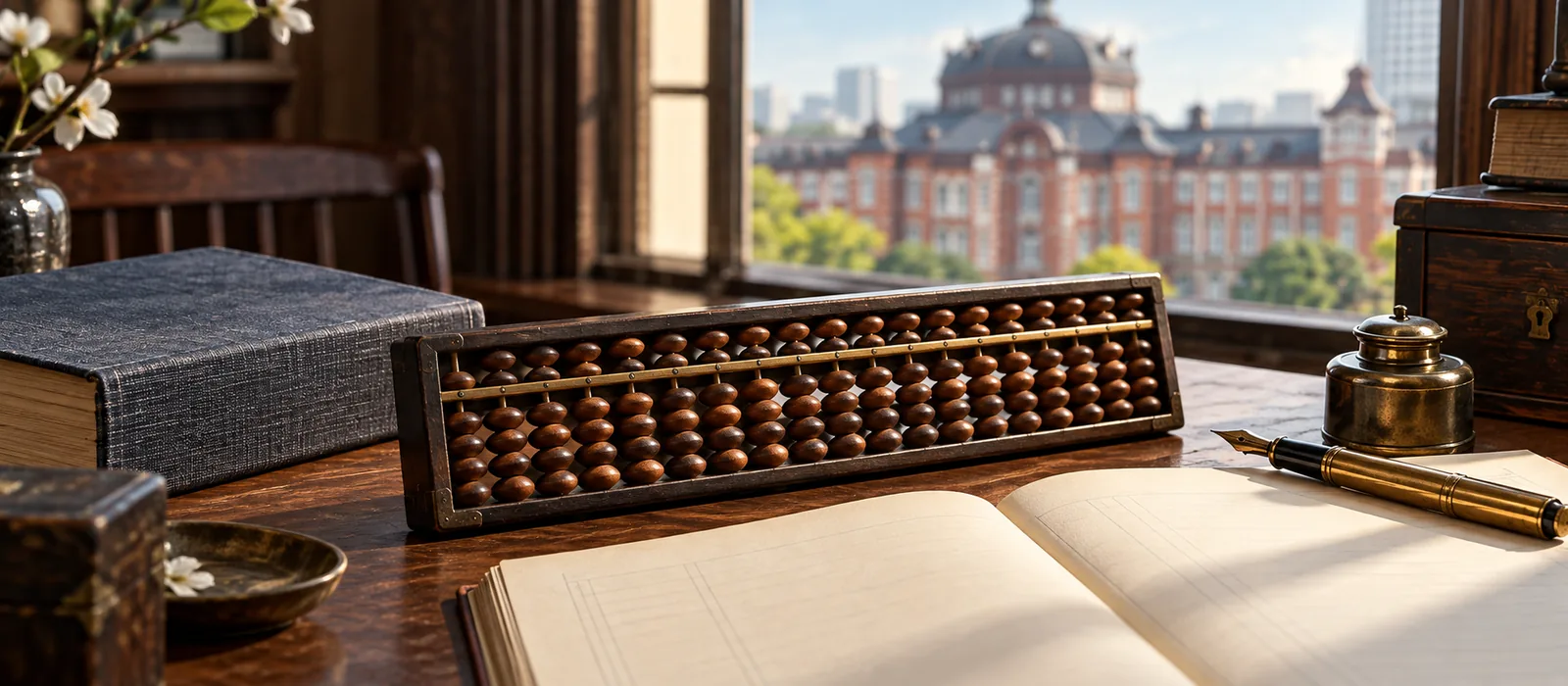
For learning, he read the Analects of Confucius and other Chinese classics with his cousin Odaka Junchu. A boy who did sums all day and read the Analects as a child: that combination ran through his whole life, and the title of his late book was The Analects and the Abacus.
He describes the magistrate episode in detail in Amayo-gatari. What he could not accept was the status system itself: however good a farmer was at business, he still had to bow before a samurai. Before long, that anger turned into action.
Sources: Saitama Prefecture: Shibusawa Eiichi chronology, Shibusawa Eiichi Memorial Foundation: chronology.
The arsonist he nearly became (1863 to 1867)
In 1863, at 23, Eiichi drew up a plan with Odaka Junchu, his cousin Shibusawa Kisaku, and others: seize Takasaki Castle, march south, and burn the foreign trading houses in Yokohama, lighting the signal fire for expelling the foreigners. They had begun gathering weapons.
At the last moment Odaka Chōshichirō stopped them. Just back from Kyoto, he told them the situation there had changed, radical anti-foreign activists were being purged, and an uprising of a few dozen men would only get them killed. After a long argument they gave up. Had he not talked them out of it, modern Japan might have lost a banker and gained one more nameless activist killed in a failed rising.
With the risk of exposure still hanging over them, Eiichi and Kisaku fled to Kyoto. There Hiraoka Enshiro, a senior retainer of the Hitotsubashi house, took notice of the two country youths and in 1864 made them retainers. Their lord, Hitotsubashi Yoshinobu, was the future last shogun, Tokugawa Yoshinobu. A year after plotting to bring down the shogunate, Eiichi had walked through the door of the shogun’s family. He put the Hitotsubashi lands’ finances in order, expanded sales of their saltpeter and cotton, and was soon trusted with more because his numbers added up.
Source: Saitama Prefecture: Shibusawa Eiichi chronology.
Cutting off his topknot in Paris (1867 to 1868)
In 1867 Yoshinobu’s younger brother, 14-year-old Tokugawa Akitake, was sent to the Paris World Exposition as the shogun’s representative. In a party of about 30, Eiichi’s job was accountant and general manager.
Before leaving he got Western formal wear in Yokohama (usually said to be a secondhand tailcoat), and not long after reaching Paris he cut off his samurai topknot; photos of him in Western dress survive. On the way they passed the Suez Canal, then under construction, and after Paris they toured Switzerland, the Netherlands, Belgium, Italy, and Britain.
What stayed with him more than the exposition itself was how money moved through society. Banks gathered many people’s small sums, joint-stock companies used them to build railways and canals, and merchants sat down with officials as equals. During that year and a half he kept the mission’s accounts, and according to biographical accounts he put funds not immediately needed into French government and railway bonds, so they showed a gain when the books were settled.
By 1868 the shogun had returned power to the emperor and the Boshin War had begun at home, so the shogunate no longer existed, and the mission sailed back at the end of the year. The wider story is in the Meiji Restoration.
Source: National Diet Library: Shibusawa Eiichi and the 1867 Paris Exposition.
Writing the rules at the Finance Ministry, then walking out (1869 to 1873)
Back in Japan he first went to Shizuoka to see the retired Yoshinobu, and in 1869 set up the Shoho Kaisho there, a public-private venture that lent money and traded goods, his first attempt to put the joint-stock idea he had seen in France into practice.
The Meiji government soon took notice. The same year he was called to the capital and spent four years in the Ministry of Civil Affairs and the Ministry of Finance, working on reforms of currency, taxation, weights and measures, railways, and the post, and in 1872 he led the drafting of the National Bank Act, where Japan’s banking system begins.
In May 1873, after disagreeing with the government over the budget, he resigned together with his superior, Inoue Kaoru. As he put it, Japan had too many officials and too few people able to run things in the private sector, and he wanted to be one of the latter.
Source: Shibusawa Eiichi Memorial Foundation: chronology.
About one company a month (1873 to 1916)
A month after resigning, in June 1873, Eiichi became general superintendent and later president of the First National Bank. Based in Kabutocho, Tokyo, it was the first bank set up under the act he had drafted himself, and after many mergers it is one of the roots of today’s Mizuho Bank.
An absurdly long resume
From then until he left business entirely in 1916, over some 40 years, he was involved with about 500 companies, roughly one a month. The count includes companies where he was a founder, director, or adviser, and his involvement varied, but many of the names are still around:
| Year | Name then (company today) | Industry |
|---|---|---|
| 1873 | Shoshi Kaisha (Oji Paper) | Paper |
| 1878 | Tokyo Stock Exchange Company (Tokyo Stock Exchange) | Securities |
| 1879 | Tokio Marine Insurance (Tokio Marine & Nichido) | Insurance |
| 1885 | Tokyo Gas | Gas |
| 1887 | Nippon Renga Seizo | Bricks |
| 1887 | Tokyo Hotel (Imperial Hotel, opened 1890) | Hotel |
Nippon Renga Seizo’s works stood in his home town of Fukaya, and most of the red bricks of Tokyo Station’s Marunouchi building were later fired there.
A quarrel with Iwasaki Yataro
Eiichi built his companies on an idea he called gappon shugi: gather the money and talent scattered across society, start ventures with it, and share the profits widely. So he usually stayed a founder or director, handed a company over once it was on its feet, and moved on to the next, never building a family conglomerate on the scale of Mitsui or Mitsubishi (a family holding company, Shibusawa Dozoku, was set up in 1915, but it was far smaller).
That put him at odds with Iwasaki Yataro, the founder of Mitsubishi. According to later biographies and recollections on both sides, Iwasaki invited him out on a pleasure boat and, over drinks, proposed that the two of them join forces and let a few capable men control business. Eiichi held to his idea, the talk went nowhere, and he left early. The writer Kawai Atsushi dates the boat trip to August 1880 (Meiji 13), but the sources do not fully agree, so the details deserve some caution. The two later clashed head-on in shipping: a company Eiichi and others backed, Kyodo Un’yu, fought Mitsubishi in a price war that nearly ruined both, until they merged in 1885 into today’s NYK Line.
Sources: Shibusawa Eiichi Memorial Foundation: chronology, Fukaya City: Shibusawa Eiichi museum.
On banknotes twice, and passed over once
Eiichi’s history with banknotes goes back much further than the 10,000-yen note, and it is more complicated.
The first time was in Korea. The First Bank he ran expanded into the Korean Peninsula, and the First Bank notes it issued in the Korean Empire between 1902 and 1904 carried his portrait. Circulating locally, those notes were seen as a sign of Japanese economic power reaching deep into Korea.
The second time almost happened in 1963. After a counterfeiting case, the government rushed to redesign the 1,000-yen note, and the final choice is said to have come down to Ito Hirobumi or Shibusawa. Ito won, supposedly in part because Shibusawa had no beard and a clean-shaven portrait was easier to forge. The story is widely told, but it remains a story; no official document confirms it.
The third time is the 2024 10,000-yen note. According to news reports, when the designs were announced in 2019, several South Korean news outlets pointed to the 1902 First Bank notes and criticized Japan for choosing a figure they saw as a symbol of economic aggression. In Japan he is the father of capitalism; on the Korean Peninsula his face calls up a different memory. Both views have their grounds, and both are worth keeping in mind when reading his story.
Source: National Printing Bureau: new Bank of Japan notes.
The poorhouse, The Analects and the Abacus, and the blue-eyed dolls (1874 to 1931)
Beyond companies, he is counted as having been involved in about 600 educational and public-interest causes over his life, and the longest was the Tokyo Yoikuin, a public institution for the homeless, orphans, and the elderly. It was always short of money and in the 1880s the Tokyo prefectural assembly moved to end its funding, but Eiichi raised donations to keep it going. He became its administrator in 1876 and its director in 1879, and ran it until his death, more than half a century in all. Today’s Tokyo Metropolitan Institute for Geriatrics and Gerontology grew out of it.
In 1916 he published Rongo to Soroban, The Analects and the Abacus. Its core idea is that making money and acting rightly do not conflict, and that profit gained without principle does not last. The book has been reprinted for over a century and is still a common sight on Japanese bookshops’ business shelves.
The most poignant story comes from his last years. In the 1920s, as the US immigration law excluding Japanese strained relations, the missionary Sidney Gulick started a campaign to send dolls to Japanese children, and in 1927 about 12,000 “blue-eyed dolls” arrived at Japanese schools and kindergartens. Eiichi led the Japanese side in receiving them and organized 58 Japanese dolls sent back in return. A decade and a half later, in the Pacific War, many of the dolls were destroyed as “enemy dolls”. Some people hid them, and a little over 300 are known to survive in Japan today.
Shibusawa was nominated for the Nobel Peace Prize in 1926 and 1927. He died in Tokyo on November 11, 1931, at the age of 91.
Sources: Shibusawa Eiichi Memorial Foundation: chronology, Yoshitake Nobuhiko, “International Politics of the Nobel Prize: The Nobel Peace Prize and Japan”, Chiiki Seisaku Kenkyu 14(2-3), 2012.
Places to visit today
To trace his life, plan two days: one in Oji in Tokyo and one in Fukaya in Saitama.
Oji: the Shibusawa Memorial Museum on Asukayama
Asukayama Park, about 5 minutes on foot from the south exit of JR Oji Station, is the site of the house where Eiichi spent his later years. The Shibusawa Memorial Museum in the park tells his life story and the history of his companies, and beside it stand two Taisho-era buildings, the Western-style tea pavilion Bankoro (1917) and the library Seien Bunko (1925). Both are Important Cultural Properties, and foreign guests were once entertained here.
Admission is JPY 500 for adults (same-day tickets only), from 10:00 to 17:00 (last entry 16:30), closed on Mondays (open on public holidays); ordinary visits need no booking. The museum is closed from November 30, 2026 to February 19, 2027, so check the website before a winter visit. Asukayama Park itself is free and one of Tokyo’s best-known cherry blossom spots.
Fukaya: the family home, the memorial hall, and a brick station
In Chiaraijima, the former Shibusawa residence Naka-no-ie, the house the family actually lived in, is open to the public by Fukaya City, and the nearby Shibusawa Eiichi Memorial Hall displays material on his life. Both are about 5 to 6 km from JR Fukaya Station, 15 to 20 minutes by car.
Look back at Fukaya Station as you leave: its facade copies the red brick of Tokyo Station, commemorating the bricks Nippon Renga Seizo supplied for it.
Sources: Shibusawa Memorial Museum: visitor information, Fukaya City: Shibusawa Eiichi museum.
Common misunderstandings
Last, a few points people often get wrong.
The first is assuming he was born a samurai. He was a farmer’s son who got into the Hitotsubashi house and then the Meiji government on ability, which is why he spent his life opposing the habit of putting officials above private citizens.
The second is picturing him as head of a zaibatsu family like Mitsui or Mitsubishi. He was involved in many companies, but mostly without family control; the 1915 Shibusawa Dozoku company was a family asset manager, far from those groups in scale and approach.
The third is reading “about 500 companies” as 500 companies he founded single-handed. The number includes roles as founder, director, and adviser, with very different degrees of involvement.
The fourth is thinking he opposed the shogunate all his life. He did want to topple it as a young man, but he kept up a lifelong relationship with Yoshinobu and, late in life, spent more than 20 years leading the compilation of The Biography of Tokugawa Yoshinobu.
Useful terms
- Shibusawa Eiichi: the subject of this article
- Amayo-gatari: his dictated memoir
- Gappon shugi: his idea of pooled capital
- Rongo to Soroban: The Analects and the Abacus
- Shibusawa Shiryokan: the Shibusawa Memorial Museum
References
- Shibusawa Eiichi Memorial Foundation: chronology
- Saitama Prefecture: Shibusawa Eiichi chronology
- National Diet Library: Shibusawa Eiichi and the 1867 Paris Exposition
- Shibusawa Memorial Museum: visitor information
- Fukaya City: Shibusawa Eiichi museum
- National Printing Bureau: new Bank of Japan notes