
Tea Ceremony and Everyday Aesthetics: Room, Season, Utensils, and Host-Guest Attention
Understand tea through rooms, gardens, utensils, seasonality, hospitality, and the labor behind Japanese aesthetics.
Chanoyu is not only a quiet bowl of matcha. It is a system of rooms, utensils, sweets, seasonal signs, school lineages, and repeated practice. The visitor may see 60 minutes; the host may have spent years learning how to clean, turn, carry, bow, and pause.
The three Senke lineages
Sen no Rikyu, who lived from 1522 to 1591, shaped the tea ideals later described through words such as wabi and ichigo ichie. After Rikyu, the Sen family tradition developed into three main houses: Urasenke, Omotesenke, and Mushanokoji-senke. They share ancestry but differ in training style, forms, and institutional networks.
Urasenke is especially visible internationally, while Omotesenke and Mushanokoji-senke maintain their own teaching traditions. When a Kyoto or Tokyo experience says “tea ceremony,” it may be a 45-minute tourist session, a cultural workshop, or a lesson connected to a specific school.
Basic temae movement
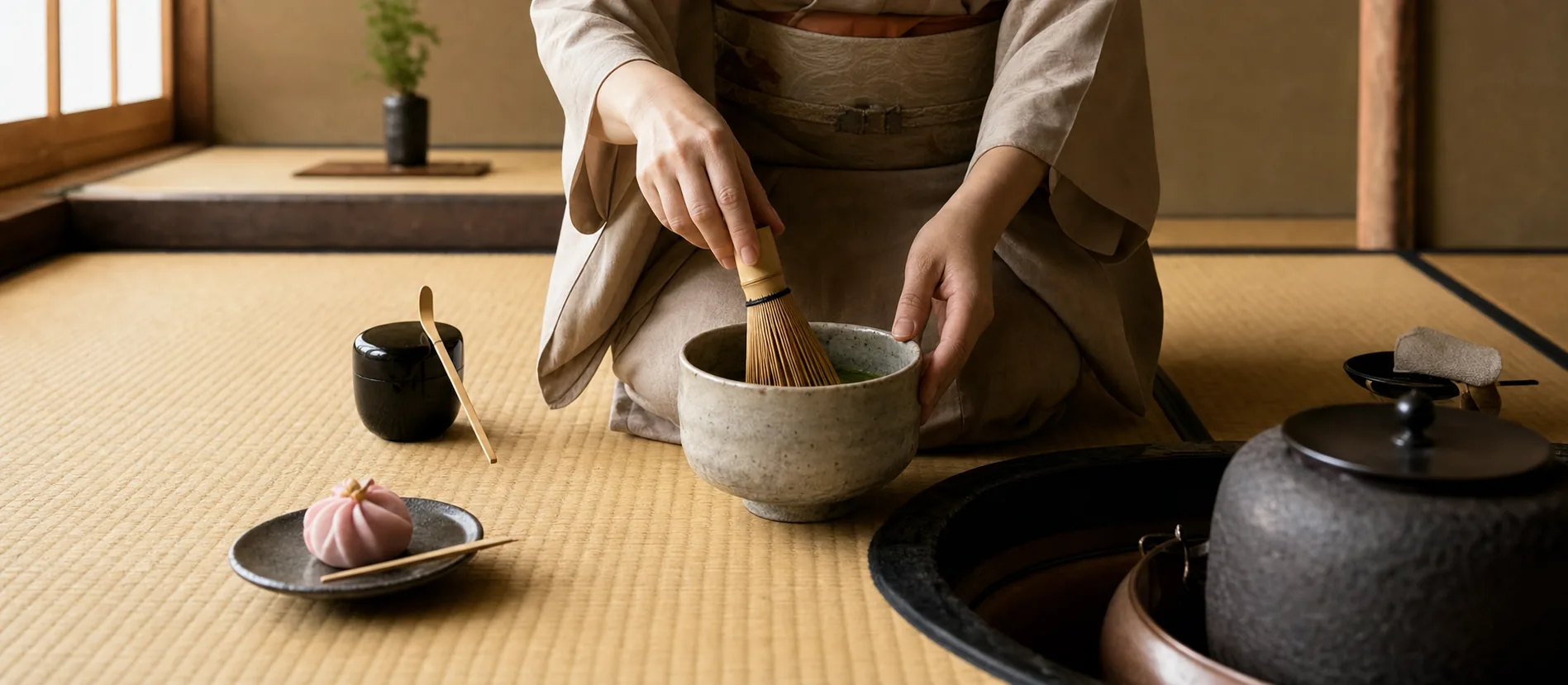
A simplified temae still has an 8-step sequence: enter the room, greet, bring utensils, purify the tea container and scoop, warm the bowl, prepare matcha, serve the guest, clean the utensils, and close the setting. The movement is slow because each step is visible to the guest.
For usucha, a common bowl may use around 2 grams of matcha and 60 to 80 milliliters of hot water, whisked for about 30 to 60 seconds. These numbers vary by teacher and bowl, but they show that tea is not improvised decoration. It is measured practice.
How beginners can experience it
Short sessions in Kyoto, Tokyo, Kanazawa, and tourist areas may cost about 1,500 to 5,000 yen. More formal kimono, garden, or private-room experiences can be much higher, sometimes 10,000 to 30,000 yen. Booking sites such as Klook, KKday, Veltra, and Ikkyu list many sessions, but the quality depends on instructor, setting, and group size.
If you want to study, weekly lessons are usually more useful than one luxury session. Some classes meet 12 or 24 times a year; others meet weekly. Ask about school lineage, monthly fee, utensil costs, kimono expectations, and whether beginners can start with casual clothing.
Wagashi and season
Wagashi is not only a sweet before bitter matcha. It introduces season, texture, and color into the gathering. Spring may bring cherry motifs, early summer may use fresh green or water imagery, autumn may suggest maple leaves or chestnuts, and winter sweets may feel heavier.
The sweet is usually eaten before drinking the tea. Watch how other guests pick it up, cut it, and place the paper. If you are unsure, a quiet 「osakini」 before drinking or eating ahead of the next guest is often appreciated.
Common mistakes
Do not treat the room as a photo studio. Ask before photographing utensils, alcove scrolls, flowers, or other guests. Avoid strong perfume because scent matters in a small tea room. Socks should be clean, and bare feet are usually avoided on tatami.
The most important point is not memorizing every gesture. It is noticing that host and guest make the space together. A beginner who watches carefully, moves slowly, and asks at the right moment usually fits better than someone trying to perform expertise.
Useful terms
- Chanoyu: the way of tea
- Temae: tea-making procedure
- Usucha: thin tea
- Wagashi: Japanese confectionery
- Ichigo ichie: one time, one meeting