
Healthcare and Insurance in Japan: How to Prepare for Care
Understand insurance enrollment, clinic flow, My Number insurance-card materials, and what to verify locally.
Japan’s public medical insurance is built around a simple counter rule: enrolled people usually pay 30% at the clinic or pharmacy. The hard part is keeping enrollment current when you arrive, move, change jobs, resign, or switch to My Number health insurance card use.
Which insurance applies
Company employees usually join employer health insurance such as Kyokai Kenpo or a health insurance society. Self-employed people, students, unemployed residents, and some dependents join National Health Insurance at the municipal office.
When you move in or leave a company plan, finish the municipal process within 14 days where applicable. If you visit a clinic without valid insurance, you may pay 100% first and later apply for reimbursement.
Clinic and hospital use
For fever, cold symptoms, chronic medication, skin problems, dentistry, eye issues, or minor injuries, start with a nearby clinic. Larger hospitals often expect a referral letter and may charge a selected medical care fee for first visits without referral.
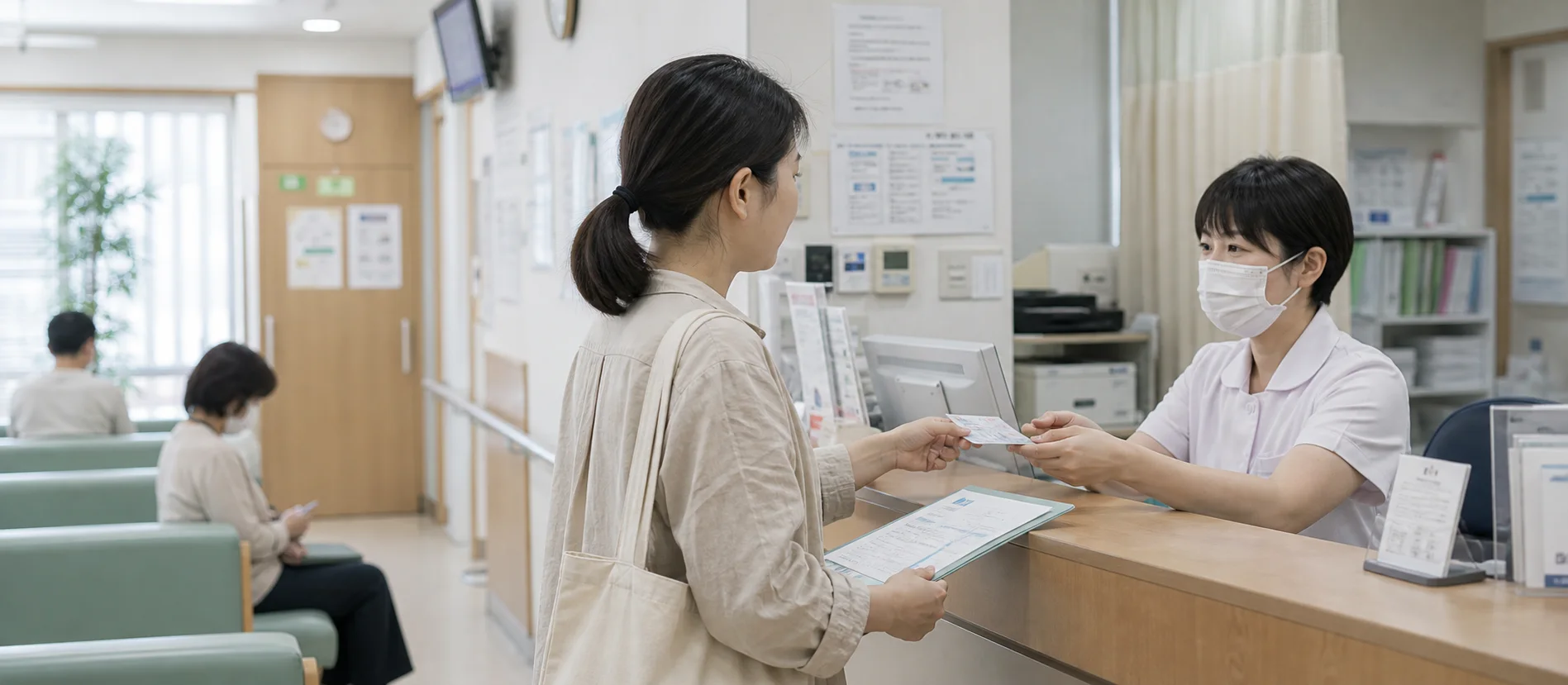
At reception, show your My Number health insurance card or a qualification confirmation document (the old paper insurance card stopped being issued in December 2024 and expired in December 2025), fill in the medical questionnaire, see the doctor, pay the 30% share, receive a prescription, and take it to a pharmacy. Prescriptions are usually valid for 4 days.
Costs and high-cost care
A normal clinic visit plus medicine may be around JPY 2,000 to 5,000 with insurance, but tests, imaging, and specialist care raise the amount. Children, people aged 70 to 74, and people aged 75 or older have different burden ratios or local subsidies.
The high-cost medical expense system caps monthly out-of-pocket burden by income band. For hospitalization or surgery, ask the insurer or municipality about a limit application certificate before payment.
For income up to roughly JPY 3,700,000, the monthly cap is often JPY 57,600, or JPY 35,400 for resident-tax-exempt households. For income around JPY 3,700,000 to 7,700,000, the common formula is JPY 80,100 plus 1%. Getting a limit application certificate before hospitalization prevents paying a large amount first and waiting for reimbursement.
Pharmacy and medication notebook
Take the prescription to a dispensing pharmacy, including chains such as Matsumoto Kiyoshi, Welcia, Cocokara Fine, or Sundrug where a prescription counter is attached. Prescription medicine is covered by insurance; a 7-day antibiotic course may leave JPY 500 to 1,500 out of pocket.
The medication notebook records what has been dispensed. Showing it each time can reduce the pharmacy charge by around JPY 40 to 100 and helps pharmacists catch duplicate ingredients across clinics. If you want generics, tell the doctor or pharmacist that generic medicine is fine.
Language and emergency support
AMDA International Medical Information Center, JNTO medical institution search, Tokyo medical interpretation services, and hospital interpretation tools can help when Japanese is difficult. Write symptoms, date, temperature, allergies, and medicines on paper or in a translation app.
For emergencies call 119. In some prefectures, #7119 helps decide whether symptoms need ambulance or urgent care. Ambulance transport itself is free, but hospital treatment is billed under insurance rules.
Common mistakes
Do not ignore insurance after moving or resigning. A 14-day delay can create refund paperwork or unpaid-premium problems. Do not go directly to a university hospital for a mild case unless you accept the extra first-visit fee.
Without valid insurance, you may pay 100% at the counter and later apply to recover the covered 70%. Keep receipts, medication notebook, referral letter, test results, and pharmacy records. They are useful for high-cost medical care, private insurance claims, and tax medical-expense deductions.
Useful terms
- Kenko hoken: health insurance
- Kokumin kenko hoken: National Health Insurance
- Kogaku ryoyohi seido: high-cost medical expense system
- Shokaijo: referral letter
- Okusuri techo: medication notebook