
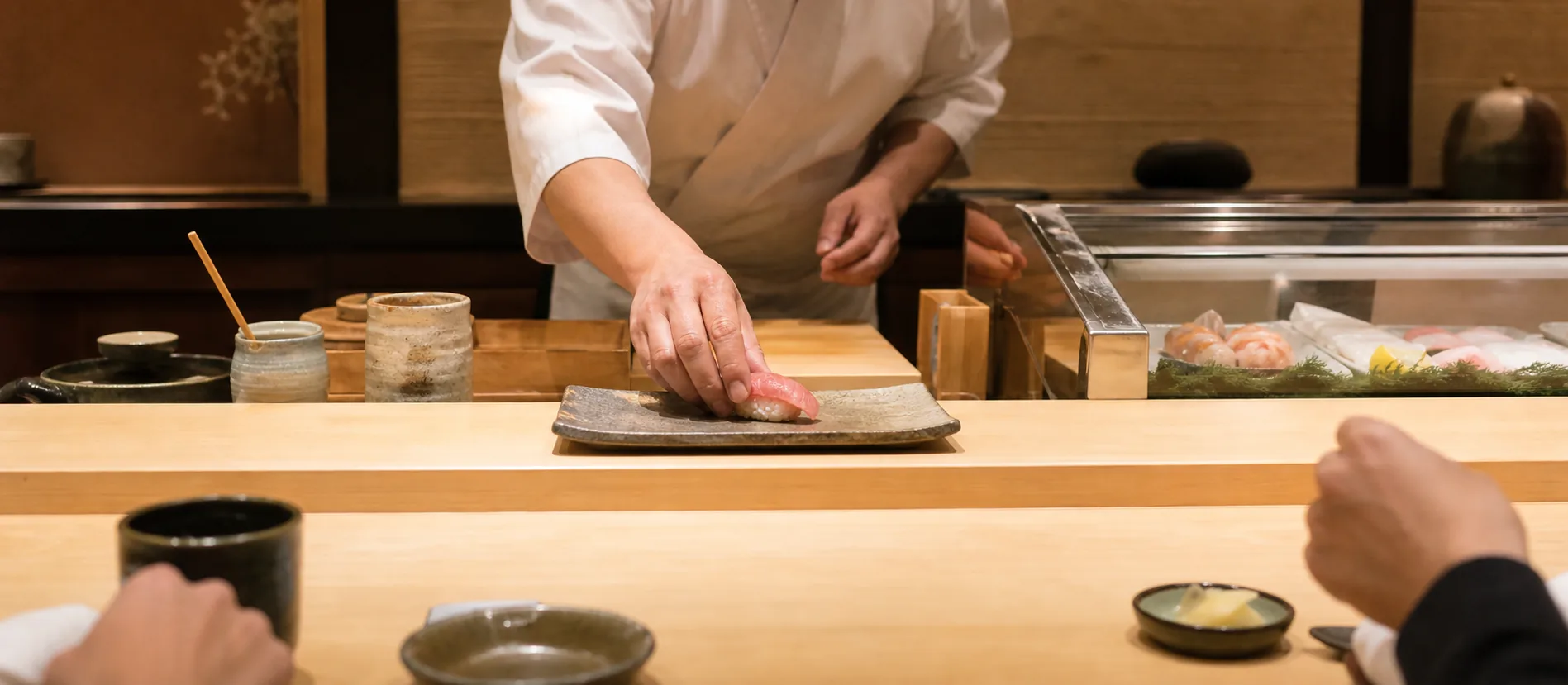
Sushi shops: reservations, counter manners, and payment
Understand sushi shop types, booking platforms, allergy notes, counter flow, soy sauce, photos, and budgets.
Sushi rules depend first on the shop type. A ¥2,000 conveyor-belt lunch, a ¥10,000 local omakase counter, and a ¥40,000 Ginza course do not use the same booking method, pace, or freedom to order.
Shop types and budgets
Standing sushi is the easiest entry point: expect about ¥150 to ¥500 per piece and ¥1,500 to ¥3,000 per person. It is usually walk-in, fast, and built for short stays.
Conveyor-belt chains such as Sushiro, Kura Sushi, Kappa Sushi, and Hama Sushi often price plates from about ¥120 to ¥500. A casual meal lands around ¥1,500 to ¥3,000, while higher-end conveyor shops can reach ¥250 to ¥700 per plate and ¥4,000 to ¥5,000 per person.
Local mid-range counters often offer omakase from ¥6,000 to ¥12,000, with lunch sets around ¥3,500 to ¥5,000. Reserve 3 to 7 days ahead by phone or TableCheck if the shop is small.
High-end counters in Ginza, Shinbashi, Toranomon, Azabu, and Kyoto Gion commonly run ¥18,000 to ¥35,000 for omakase. Top shops can reach ¥40,000 to ¥60,000 and may require booking 30 to 90 days ahead.
Reservations and allergies
OMAKASE, Pocket Concierge, and TableCheck cover many serious counters. OMAKASE lists more than 130 high-end restaurants, often opens seats about 30 days ahead, charges a ¥390 service fee, and may require prepayment.
Many small or high-end shops still use phone-only booking. If Japanese is difficult, a hotel concierge can help. Give allergies, religious limits, pregnancy restrictions, and strong dislikes when booking, not after sitting down.
Omakase kitchens buy fish by guest count, often through Toyosu market supply routes early in the morning. If the chef learns at 19:00 that you cannot eat shellfish, blue-backed fish, or raw egg, the course may already be impossible to adjust cleanly.
Arrival and course flow
Arrive about 5 minutes early. A delay of more than 10 minutes can break a small counter’s timing, and prepaid bookings may have strict cancellation rules. Avoid perfume, keep the counter clear, place coats and bags under the seat, and use the oshibori for hands, not for wiping the table.
A typical course may begin with a small starter, chawanmushi, or pickles, then move through 2 or 3 sashimi pieces, 8 to 12 nigiri served at 30 to 90 second intervals, a makimono or soup course, and finally tea or a small dessert. When the chef says the last 2 or 3 pieces are coming, that is the point to add a request if the shop allows it.
Soy sauce, gari, and nikiri
Hands and chopsticks are both acceptable. If soy sauce is needed, touch the fish side to the soy sauce, not the rice side. Rice falls apart easily and absorbs too much salt.
Some nigiri already has nikiri soy sauce brushed on by the chef. In that case, do not add more soy unless the shop clearly expects it. For gunkan sushi, use a piece of gari as a brush if dipping would spill the topping.
Gari is for resetting the palate between pieces. It is not a salad, and piling it onto every piece can hide the temperature, fat, vinegar, and salt the chef is trying to balance.
Photos and payment
Ask “shashin totte mo ii desu ka” before taking photos. Avoid flash, and ask separately before photographing the chef or other guests. Phone calls at the counter are poor form; step outside if the shop allows re-entry.
Payment comes after the course unless the platform prepaid the meal. Check whether drinks, service charge, tax, or cancellation fees are separate, because a ¥25,000 course can become more expensive after sake and supplements.
Useful terms
- omakase
- nigiri
- nikiri
- gari
- gunkan
- chawanmushi