
First Week in Japan: Address, Phone, Insurance, and Money
A practical sequence for making your residence card, address, contact, health insurance, and payment setup usable.
The first week after landing is a sequence problem. Within 14 days after deciding your address, you need municipal registration, residence-card address writing, National Health Insurance if not covered by work, National Pension where applicable, and the My Number notice route. Without that address record, banks, mobile carriers, and housing contracts often stop.
Day 1: arrival and transport
At major airports such as Narita, Haneda, Kansai, Chubu, Fukuoka, and New Chitose, many long-term entrants receive the residence card at immigration after passport, visa, COE, fingerprints, and photo checks. The address field on the back is blank until the municipal office writes it after move-in.
Keep JPY 10,000 to 30,000 in cash for the first ride and food. Narita to Tokyo can be around JPY 3,070 by NEX or JPY 2,580 by Keisei Skyliner; Haneda to Shinagawa by Keikyu can be around JPY 330. If you carry 2 suitcases or children, luggage delivery to the hotel can be worth the JPY 2,000 to 4,000 per item.
Day 2 to 3: fix an address
Municipal registration, banking, and phone contracts need a real address. Many newcomers stay in a hotel, dormitory, company housing, or short-term rental for 1 week to 1 month while completing the apartment search.
For a rental apartment, expect search, viewing, application, guarantor-company screening for 5 to 7 days, contract, payment, and key handover. Initial costs often equal 4 to 6 months of rent. For an JPY 80,000 apartment, the first payment can be JPY 400,000 to 650,000.
Day 4 to 5: municipal office
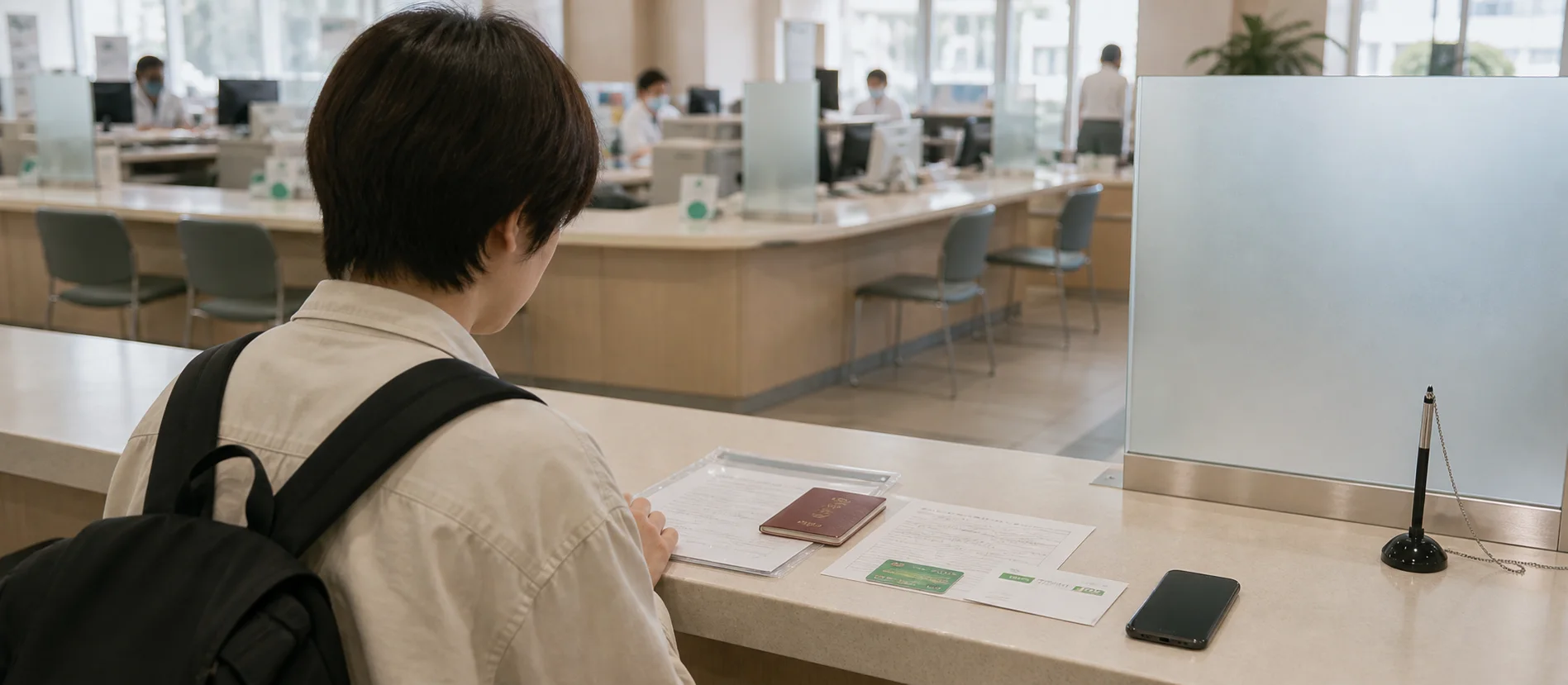
After the address is fixed, go to the city or ward office. Handle move-in notification, address writing on the residence card, National Health Insurance, National Pension where needed, My Number notice handling, and seal registration if you need a registered seal.
Bring residence card and passport. Offices are usually open on weekdays around 8:30 to 17:00, with some evening or Saturday counters depending on the municipality. After registration, a resident record can often be issued the same day for about JPY 300.
Day 5 to 7: bank, phone, utilities
Japan Post Bank is often the easiest first account; the cash card may arrive 1 to 2 weeks later. Megabanks such as MUFG, SMBC, and Mizuho often apply a 6-month residence rule unless the company helps with a salary account. Sony Bank and SBI Shinsei can be practical early options.
For mobile service, large carriers cost around JPY 6,000 to 8,000 for high-data plans, while ahamo, povo, LINEMO, Rakuten Mobile, IIJmio, and mineo can be cheaper. Electricity may start online the same day; gas usually needs an appointment; internet construction can take 1 to 4 weeks.
Common mistakes
Do not delay the move-in notice past 14 days. Do not try to open a bank account or sign a phone plan before the address record exists. Do not visit only a megabank and assume all banks will reject you.
Do not visit a clinic without insurance unless it is unavoidable. Without insurance you pay 100% at the counter, then need a refund procedure after enrollment. Also do not drive unless your license and International Driving Permit are valid for Japan.
Useful terms
- Tennyu todoke: move-in notification
- Juminhyo: resident record
- Zairyu card address field: address written on the residence card
- Yachin hosho gaisha: rent guarantor company
- Kokumin kenko hoken: National Health Insurance