
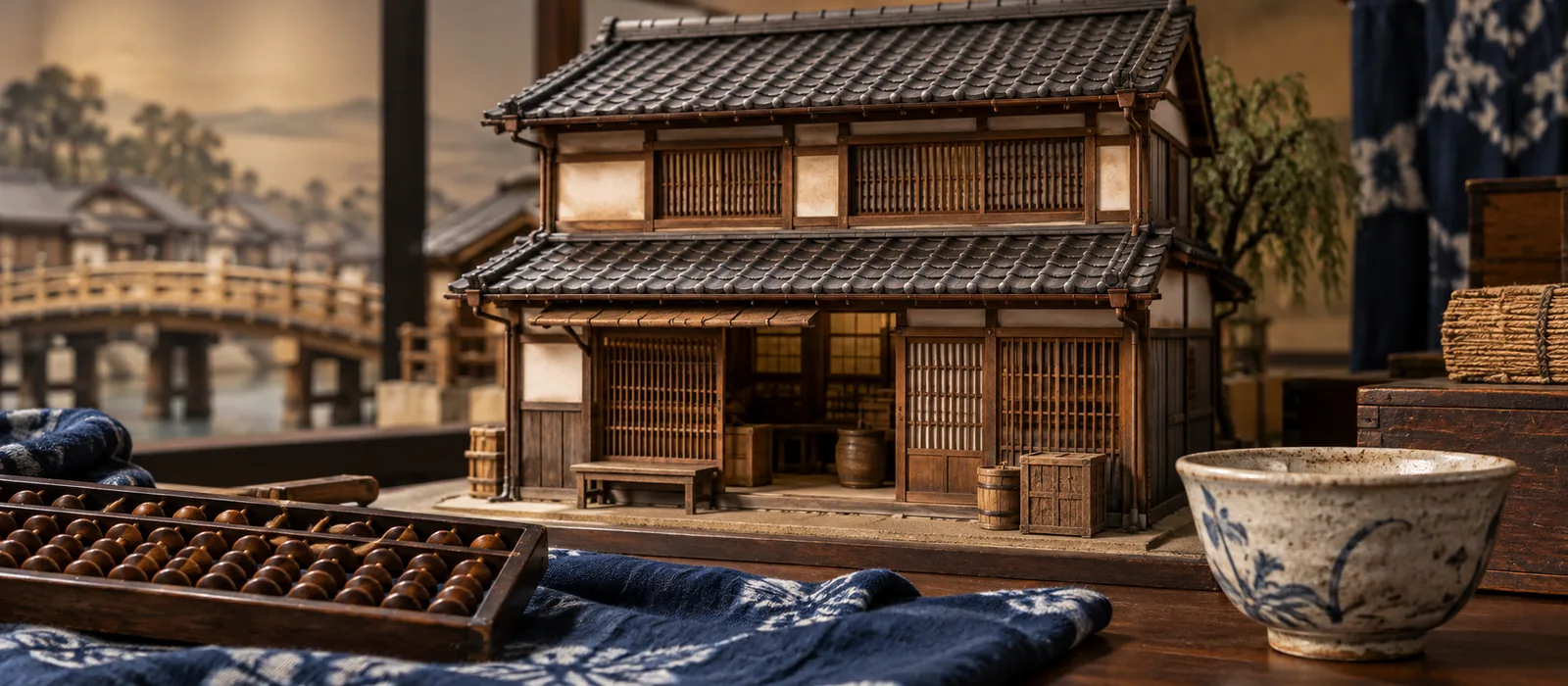
The Edo Period: Alternate Attendance, National Seclusion, a City of a Million, and Nihonbashi, the East Gardens, Fukagawa, and Dejima Today
Tokugawa Ieyasu opened the Edo shogunate in 1603, alternate attendance became compulsory in 1635, Nihonbashi was the starting point of the Five Highways, and Edo's population is estimated to have reached a million by the early 18th century. After the Great Fire of Meireki in 1657 the castle keep was never rebuilt, and during the seclusion years Japan dealt with the outside world through four gateways: Dejima in Nagasaki, Tsushima, Satsuma, and Matsumae. This walks through 260 years of Edo society, up to the eve of the Black Ships in 1853, through places you can visit today.
ARTICLE MAPReading Map
SERIESJapanese HistoryFrom the eras overview to single events, each tied to places you can still visit.8 parts
Start here
Classical and medieval
Sengoku and Edo
- 04Sekigahara
- 05Edo society
Modern era
War and postwar
The Edo period runs from Tokugawa Ieyasu becoming shogun in 1603 to the return of power to the emperor in 1867, about 260 years without a major civil war. That long peace rested on a system that kept the regional lords firmly in check, and it produced Edo, one of the largest cities in the world at the time. The sections below cover how the system worked, life in Edo, and how Japan dealt with the outside world during seclusion, matched to places you can visit in Tokyo and Nagasaki. Townspeople’s culture such as ukiyo-e and kabuki is covered in Japanese history eras, so it is not repeated here.
How the Tokugawa held 260-odd lords in check
The shogunate directly ruled key places such as Edo, Kyoto, Osaka, and Nagasaki and about a quarter of the country’s land, leaving the rest to the lords of the domains, a structure called the bakuhan system. Lords were ranked by their relationship to the Tokugawa as shinpan (relatives), fudai (hereditary vassals), or tozama (outside lords), and most tozama lords, who submitted only after Sekigahara, were placed far from Edo.
The main tool for controlling them was sankin kotai, alternate attendance. In 1635 the third shogun, Tokugawa Iemitsu, revised the Laws for the Military Houses (the Kan’ei code) to require lords to alternate years between Edo and their domains. It first applied to tozama lords and was later extended to fudai lords. Lords’ wives and heirs had to live in Edo, in effect as hostages. Moving processions of hundreds of people back and forth was hugely expensive, draining domain finances while bringing business to the highways and post towns along the way.
Nihonbashi and the Five Highways
The processions traveled the Five Highways the shogunate maintained: the Tokaido, Nakasendo, Koshu Dochu, Nikko Dochu, and Oshu Dochu, all starting from Nihonbashi bridge in Edo. Nihonbashi was first built in 1603, and the Tokaido ran from there to Sanjo Ohashi bridge in Kyoto through 53 post towns, the road Utagawa Hiroshige painted in The Fifty-three Stations of the Tokaido.
Today’s Nihonbashi is a stone arch bridge completed in 1911 and designated an Important Cultural Property. Set into the road surface at its center is the Zero Milestone of Japan, from which distances on national highways are still measured, and a replica stands in the plaza on the north side where you can see it up close. An elevated Metropolitan Expressway runs over the bridge today, and work to move it underground is under way.
A city of a million, and its fires
Edo’s population is estimated to have reached about a million by the early 18th century. Roughly half were samurai and their families and the other half townspeople crowded into row houses (nagaya). Samurai residences took up most of the city’s land, so the townspeople’s districts were extremely dense.
What such a city feared most was fire. The Great Fire of Meireki in 1657 burned most of Edo, including the keep of Edo Castle, which was never rebuilt. The shogunate then widened streets and created firebreak avenues (hirokoji) and open firebreak spaces, and in 1720 organized townspeople’s fire brigades, the machibikeshi, into 47 companies named after the syllables of the iroha.
The site of Edo Castle’s inner keep is now the East Gardens of the Imperial Palace, free to enter and closed on Mondays and Fridays (open on public holidays except the Emperor’s Birthday). The stone base of the keep survives there, about 41 m east to west, 45 m north to south, and 11 m high. To see how townspeople lived, the Fukagawa Edo Museum in Kiyosumi-Shirakawa recreates a full-size street of Fukagawa-Sagacho in the Tenpo years (1830 to 1844), with row houses, a rice shop, and a boathouse. Adult admission is JPY 400, from 9:30 to 17:00, closed on the 2nd and 4th Mondays, 3 minutes on foot from exit A3 of Kiyosumi-Shirakawa Station. The Edo-Tokyo Museum in Ryogoku reopened on March 31, 2026, after about four years of renovation.
Sources: Imperial Household Agency: East Gardens, Koto City: Fukagawa Edo Museum, Edo-Tokyo Museum.
Four gateways during seclusion
The other side of the peace was tight control of foreign contact. The shogunate banned Christianity, barred Portuguese ships in 1639, and in 1641 moved the Dutch trading post from Hirado to Dejima in Nagasaki, beginning the roughly 200-year arrangement later called sakoku, national seclusion.
Japan was not entirely closed, though. Foreign contact ran through four gateways: Nagasaki handled Dutch and Chinese merchants, the Tsushima domain handled Korea, the Satsuma domain traded through the Ryukyu Kingdom, and the Matsumae domain traded with the Ainu of Ezo. In Nagasaki, Chinese merchants lived in a dedicated Chinese quarter, the Tojin Yashiki, from 1689, while the Dutch were confined to Dejima, a fan-shaped artificial island.
Dejima was completed in 1636, and the city of Nagasaki has rebuilt several of its buildings, including the chief factor’s residence and warehouses. Adult admission is JPY 1,100, from 8:00 to 21:00 (last entry 20:40), open all year.
Source: Nagasaki City: Dejima.
On the eve of the Black Ships
In the late Edo period, foreign ships appeared in Japanese waters more and more often. In 1792 the Russian envoy Adam Laxman came to Nemuro seeking trade, and in 1808 the British warship HMS Phaeton forced its way into Nagasaki harbor. In 1825 the shogunate issued the Edict to Repel Foreign Ships, ordering coastal guns to fire on any that approached. When news came that Qing China had lost the Opium War to Britain, the shogunate relaxed the order in 1842, giving foreign ships firewood, water, and food before sending them away.
At the same time, the Tenpo Reforms tried to restore the shogunate’s finances and public morals, with limited success. In 1853 Commodore Perry’s squadron appeared off Uraga; what happened next is in the Meiji Restoration.
Common misunderstandings
Last, a few points that are often confused.
The first is expecting to see Edo Castle’s keep at the Imperial Palace. It burned in 1657 and was never rebuilt; only its stone base remains in the East Gardens.
The second is reading shi-no-ko-sho, “warriors, farmers, artisans, merchants”, as a strict four-tier caste system. Recent Japanese textbooks no longer teach it in that order. Outside the samurai, there was no fixed ranking between farmers, artisans, and merchants, and status was defined more by where people lived and what they did.
The third is thinking Japan was completely cut off during seclusion. The four gateways kept working, and Western books brought in through the Dutch at Nagasaki gave rise to rangaku, Dutch learning.
The fourth is equating Edo with today’s 23 wards of Tokyo. The city of Edo was much smaller, roughly the area inside today’s Yamanote Line and along both banks of the Sumida River.
Useful terms
- Sankin kotai: alternate attendance
- Gokaido: the Five Highways
- Meireki no taika: the Great Fire of Meireki
- Dejima: the Dutch trading island in Nagasaki
- Sakoku: national seclusion