
Renting an Apartment in Japan
A practical flow for budget, documents, guarantor company, move-in costs, inspection, and local rules.
Renting in Japan means paying several items before move-in: deposit, key money, broker fee, guarantor-company fee, fire insurance, lock exchange, first rent, and prorated rent. For many apartments, initial cost is 4 to 6 months of rent, and the standard contract term is 2 years.
Search and budget
Use SUUMO, LIFULL HOME’S, at home, Nifty Real Estate, or a foreigner-friendly site such as Real Estate Japan and GaijinPot Housing. REINS is mainly for real estate professionals, so ordinary renters use agent listings.
Keep rent under about one-third of take-home pay. A JPY 250,000 take-home salary usually makes JPY 80,000 rent more realistic than JPY 120,000. Check room type, square meters, station walk, building age, gas type, internet, sunlight, noise, and bicycle parking.
Viewing
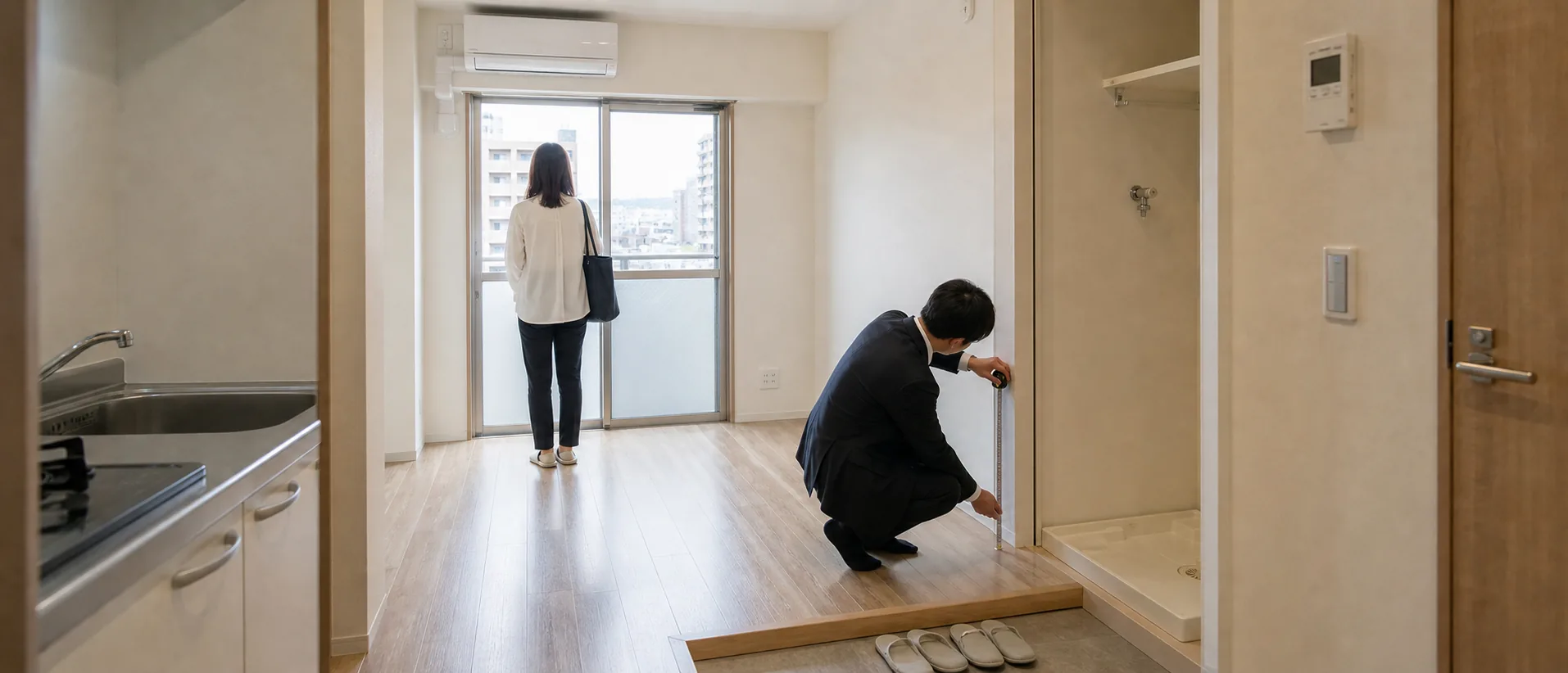
View 3 to 5 units in one day if possible. Check entrance, garbage station, bicycle area, hallway, wall damage, storage, kitchen, air conditioner age, water heater, washer pan, toilet, breaker capacity, city gas or propane, and phone signal.
Walk the route from station to building. A listing’s 10-minute walk can feel different at 23:00, in rain, or with luggage. Photograph every room and equipment label for comparison.
Application and screening
After choosing a unit, submit the application with name, date of birth, nationality, residence status, residence period, employer or school, income, emergency contact, and guarantor-company choice. Foreign applicants often need residence card, passport, employment contract or school certificate, and recent 3 months of payslips.
Guarantor screening usually takes 5 to 7 days. Common guarantor companies include Japan Safety, Zenhoren, Casa, and GTN. First-year guarantor fee is often 50% to 100% of monthly rent, with renewal fees later.
Initial costs
For an JPY 80,000 apartment, deposit can be JPY 80,000 to 160,000, key money JPY 0 to 160,000, broker fee around JPY 80,000 to 88,000, guarantor fee JPY 40,000 to 80,000, fire insurance JPY 15,000 to 20,000 for 2 years, lock exchange JPY 15,000 to 30,000, plus rent.
Furniture and appliances can add JPY 150,000 to 500,000. Free-rent, no-key-money, or no-deposit listings reduce the first bill, but check cleaning fees and early-cancellation penalties.
Contract, renewal, move-out
A normal fixed-term expectation is 2 years for an ordinary lease. Renewal can require a renewal fee equal to 1 month of rent, guarantor renewal, and fire-insurance renewal. Some regions or buildings have no renewal fee.
For move-out, give written notice 1 to 2 months ahead, attend inspection, return keys, and wait for deposit settlement. Ordinary wear is usually landlord responsibility under MLIT guidance, while smoking stains, pet scratches, holes, and deliberate damage are tenant responsibility.
Common mistakes
Even with JPY 80,000 rent, the first bill can be JPY 400,000 to 650,000. Budget for a guarantor-company fee of roughly JPY 40,000 to 80,000 in the first year instead of assuming a personal guarantor will solve screening.
Applying to a foreigner-NG unit can fail even after viewing. Confirm foreigner acceptance, residence status conditions, guarantor company, and emergency-contact requirements before submitting documents. A 2-year lease can also include a 1-month penalty or short-term cancellation fee if you leave early.
Do not accept a move-out restoration bill without checking the basis. Ordinary aging is usually landlord responsibility, while smoking stains and pet scratches are tenant responsibility. Keep photos and the written estimate before deposit settlement.
Useful terms
- Shikikin / reikin: deposit / key money
- Chukai tesuryo: broker fee
- Hosho gaisha: guarantor company
- Kasai hoken: fire insurance
- Genjo kaifuku: restoration at move-out